B2B sales outreach: my strategy guide & best practices
Author:
Karina
Published:
Jun 29, 2026
Updated:
Jun 29, 2026
Reading Time:
17min
I've run cold B2B outreach campaigns that worked and ones that completely failed. To be honest, it’s hard to master.
There are a lot of things you need to consider while planning and executing the campaign, and even doing all of that doesn't guarantee that you will succeed (most likely not). Sorry for the demotivating speech, but it’s just the reality.
You will need a lot of trial and error to get satisfying results. That’s why I decided to write this article—to make this path easier and provide best practices on sales outreach strategies based on real experience.
If that’s something you are interested in, let’s dive in.
- Why B2B sales outreach still matters in 2026
- The two B2B sales outreach channels I focus on
- Where to find warm B2B prospects
- My B2B sales outreach framework: the 6 stages
- My B2B sales outreach tool stack
- Common B2B outreach mistakes I see (and made myself)
- FAQ
Why B2B sales outreach still matters in 2026
I believe cold B2B outreach is a reliable strategy to attract new clients. It still works in 2026, but it has become harder to execute. That doesn’t mean that you shouldn’t try.
Successful sales outreach lets you reach a significant number of prospects on your own timeline without waiting for them to fall into your lap. It is a great addition to other channels like SEO, paid ads, and social media presence.
Here are a couple of reasons why you should consider including outreach in your strategy mix:
→ You control the volume.
Inbound depends on people finding you. Outbound shifts control to you, and you can decide how many people you want to reach out to this week.
Then it’s simple math: if out of a thousand prospects you get 10 leads, in order to get 30 leads, you roughly need to contact 3,000 people. It isn't always that consistent (too bad), but you get the point.
→ You can target precisely.
If you build your ICP properly and find people with whom your product and/or services truly resonate, you have a much higher chance of working with your ideal client.
I have a separate article that covers this topic in-depth.
→ The feedback comes back fast.
If you use multiple marketing channels (SEO, social media, outdoor, radio, etc.), you probably know that it takes a lot of time to see results and understand how well these tactics are performing.
Feedback comes back much faster with sales outreach. You can see if your messaging resonates within weeks or sometimes even days. Based on that, you can adjust and experiment in a shorter time span.
→ It works for small teams.
This channel doesn’t require 10 people and tons of budget to handle. Of course, it can be that way. Some companies spend huge amounts of money on an outreach strategy, but it isn't necessary.
One person with a good list and a good message can create a decent outreach campaign.
The caveat is that the rules of the game have changed, and it’s getting harder and harder to actually reach people and get their attention.
So, how is "modern sales outreach" different from the “old” one?
The fundamentals for B2B outreach strategies stay the same. You still need the right message in front of the right person at the right time (like pretty much in every marketing channel). What’s changed (in my opinion) is the environment around it and the difficulty of execution.
The recipients’ inboxes are extremely crowded, companies try to sell different things to people all the time, and prospects have seen every generic "I came across your profile" opener a hundred times.
At the same time, they've seen very creative messaging and approaches. It is much harder to catch a prospect’s attention now.
To sum it up:
→ The personalization bar is higher.
Inserting their first name into a template doesn't count anymore. Almost every person can spot mass automation in two seconds.
What do you do? I gathered some examples of personalization that isn't generic, with a lot of templates available. You can check it out for some inspo.
→ Deliverability is harder.
Email providers are stricter about cold outreach. You need to dive into this topic before you start sending emails; otherwise, you risk being blocked.
Domain warm-up, sender reputation, and proper authentication aren't optional anymore. There are some platforms (one example is Snov.io) that help with domain warm-up to minimize the risk.
→ Multichannel is the default.
Improve your outreach by using multiple marketing channels. The key here is to get your company out there to be seen by different people at different places.
You need to build brand awareness and brand recognition to gain trust. That path takes more time, effort, and money, but it’s the most holistic approach that will keep bringing in new clients.
→ AI is in the mix.
You need to learn how to use AI. I can see that some teams use it really well. They use it for research, automating the processes, teaching bots, etc. Others just use it to write generic messages.
Sit down and think about how you can use AI to speed up the most repetitive process across multiple channels. AI can even help you with that 😂. Describe your business and ask how ChatGPT or Claude could help you.
The two B2B sales outreach channels I focus on
There are many outreach channels you could use: cold email, LinkedIn, cold calling, and even direct mail. I'll focus on the two that have worked best for me in the campaigns I've run.
Those are cold email campaigns and LinkedIn outreach.
Cold email outreach
Email outreach is very well known and commonly used by a lot of companies.
The plan there is pretty straightforward. You need to build your ICP, collect a prospect list, write an email sequence (initial message + follow-ups), send your messages through a cold email platform, and track opens and replies.
It sounds easy enough, but obviously, there are a lot of nuances at every step. If you want to dive deep into each step, I have a whole list of articles for you:
→ B2B list building (ICP building and contact collection)
→ How to write email sequences with examples and email templates
→ Platforms to use for B2B outreach
→ Benchmarks and metrics for cold outreach (KPIs for open rates, response rates, etc.)
When is email outreach the right channel?
I'd say it's when you need volume, when your offer is broadly relevant across an industry, and when you have a clear ICP but don't need a relationship too close.
I'm not saying you can't have close relationships with email prospects, but it's not as crucial as it is on LinkedIn.
What makes cold email outreach hard now: inbox saturation, new deliverability rules, and the use of generic 'I came across your profile' templates.
I feel like people have seen it all, and it’s really challenging to capture prospects’ attention.
All that said, I think that email outreach should still be one of your marketing channels. It keeps proving its effectiveness if done right.
LinkedIn outreach
LinkedIn outreach has its own execution plan. It also includes building your ICP, collecting prospects, and writing message sequences.
What distinguishes LinkedIn outreach from email outreach is the need to send a connection request and get it accepted. The profile you use for outreach should also be optimized and look trustworthy.
I have a separate article that talks about LinkedIn outreach extensively with real-life campaign examples.
When is LinkedIn outreach the right channel?
In my opinion, it’s when your offer fits a specific role/seniority, when relationship matters more than volume, and when prospects need warming before they'll engage.
What makes it hard now: LinkedIn limitations (100-200 connection requests per week), a narrower audience since you need to get your invite accepted before you can write an actual message, and a longer sales cycle if you need to warm up your leads first.
Now I want to talk about where to find warm leads or how to make them warm.
Where to find warm B2B prospects
Before you start any outreach campaign, you need a list of prospects/leads. Those leads can be cold or warm (they can also be hot, but we aren’t gonna talk about it here).
So, who are warm leads? Those are people who already have some connection to you: they attended your webinar, commented on one of your posts, downloaded something from your site, followed your newsletter, etc.
As you probably already know, warm leads are more likely to convert than cold leads with the same message. They already know about your brand and have a certain level of trust towards your products and/or services.
Here’s where I look for warm leads.
Event and webinar attendees
This is probably one of your best sources for warm sales leads. Whether you host or attend an event, you can be sure attendees are familiar with the topic and more open to services related to it.
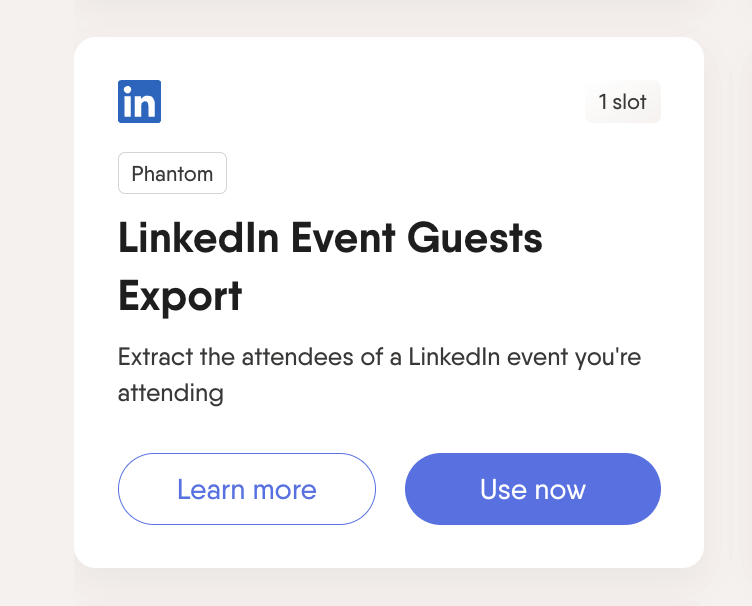
I personally use PhantomBuster’s LinkedIn Event Guests Export. I feel like it’s a must-have for LinkedIn lead generation.
I talk about how to do it step-by-step in my B2B list building article.
Engaged LinkedIn post commenters
This is another audience type that you can use for your outreach.
If you are a B2B marketer, you probably know that not many companies or personal pages have a lot of post comments.
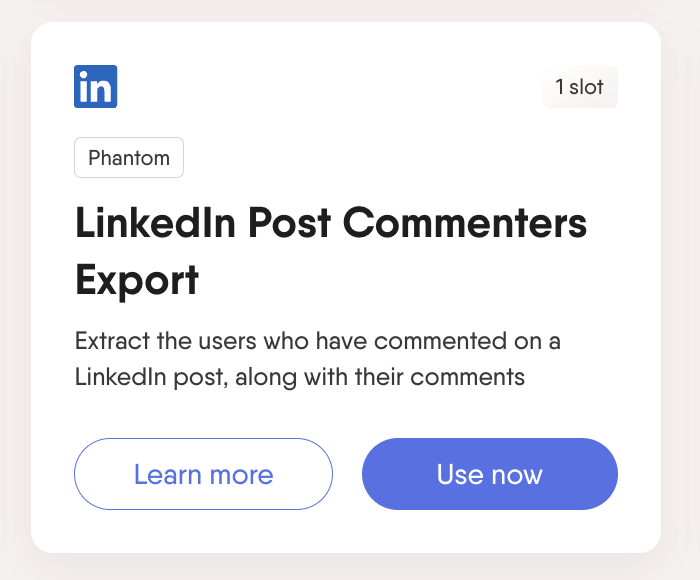
But if you do have people who are actively commenting on your posts, you can add them to your prospect list. You can scrape those contacts either manually or using another feature from PhantomBuster.
Newsletter and content subscribers
This audience works great for multiple reasons. First, they already gave you their permission to email them. Second, they already know about your company and are familiar with your brand. You've already built relationships with them in one way or another.
That's the warmest cold list possible.
You need to be careful with this list, though. If you email and try to sell something to these people all the time, you are going to lose their trust and your credibility.
Try segmenting the audience you have and suggest products or services to people who might be genuinely interested in them. Also, track when you last emailed each person with a sales pitch. Keep those intervals long enough.
Past website visitors
This is another audience type worth considering. These people most likely already have an intent to buy a product or service since they were browsing the website. They might even remember your company and brand if you contact them.
How do you collect these prospects?
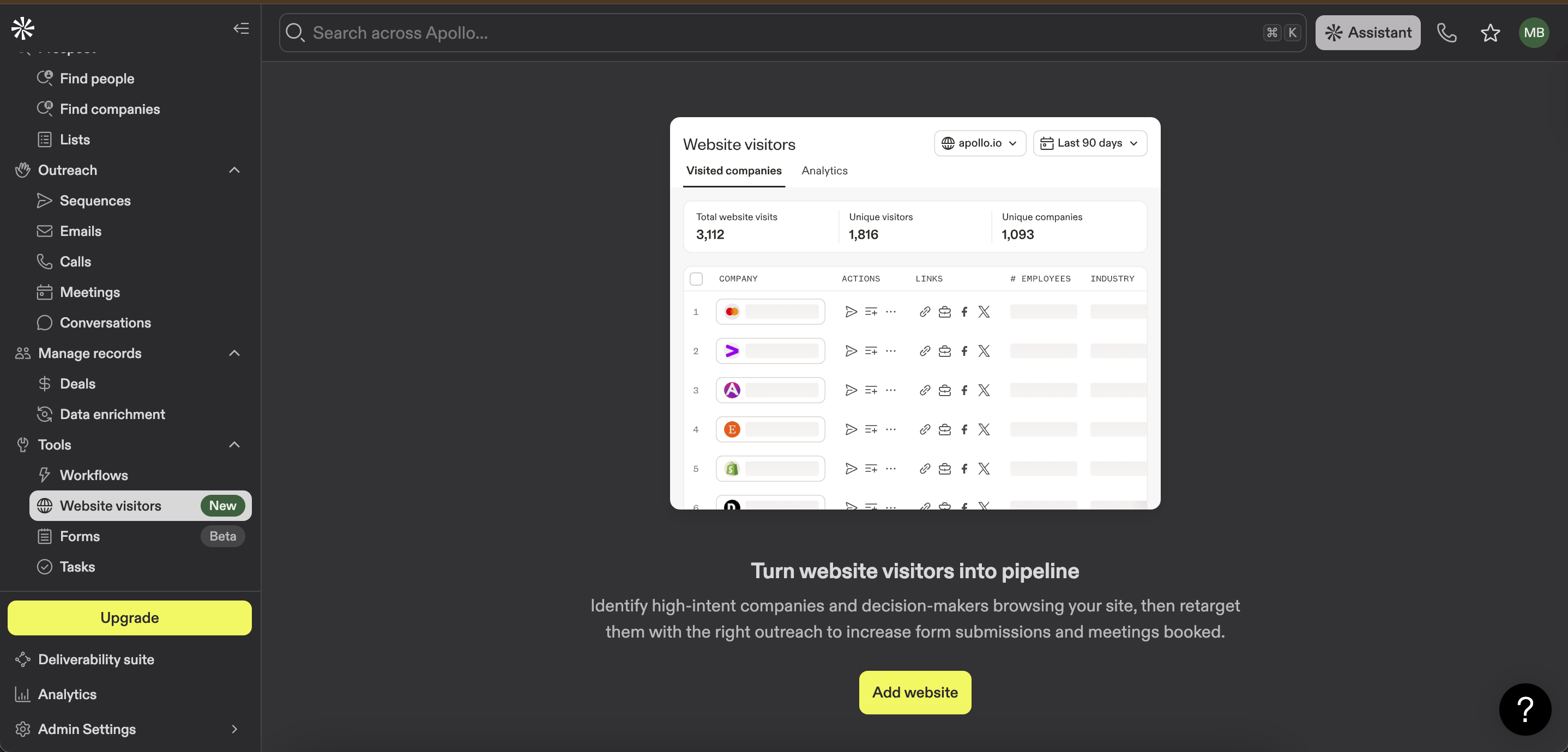
Apollo has a great feature that tracks your website visitors. I consider it extremely valuable because you can see what kind of audience is visiting your website.
You can use all of these channels to gather warm leads. I understand that some companies (especially small ones) might not have a lot of prospects to collect using these methods, but it’s a good start.
Sometimes 50 warm prospects can make you more sales than a thousand cold ones.
My B2B sales outreach framework: the 6 stages
I defined 6 stages of the outreach process for myself. I find it the easiest and most reliable way to conduct different kinds of outreach campaigns. Let’s dive into them.
Stage 1. Define your ICP and target prospects
This is the fundamental stage of effective sales outreach. If you can't describe your product, what problems it solves, and who has those problems, you are doomed.
You really need to take your time here. Do not rush this. You might not hit the perfect audience on the first try, but you should try to be close enough.
I'll give you example charts you can use to unpack your product and describe your ICP.
Product/service unpacking.
Based on that, you can build your ICP.
After you do this exercise, believe me, it will be much easier to collect a prospect list. You might add additional filters that you consider important, for example: decision-makers, changed jobs less than 6 months ago, got promoted recently, etc.
It can help you to narrow the search even more.
Stage 2. Choose your channel (or channels)
Your channel choice will depend on multiple factors here.
First, look at what you wrote in the “Where they hang out online” section in your ICP chart. Start from there.
Most of the time, you'll see that multiple channels can fit. How do you choose which one to go with? Should you do a multichannel campaign in that case?
My suggestion is to start with the channel you're most confident about, and after you master it, move on to multichannel campaigns.
That will help you to better understand your audience and tune the messaging before putting all your efforts into many different channels that you don’t know how to work with.
What if that is your first outreach campaign ever, and you don’t feel confident about any of the channels? Think strategically here. Which channel will require less time and effort while giving the most benefit?
I’d say if you are a small team with a limited list of prospects, go with LinkedIn outreach. If you have a bigger prospect list and a warmed-up domain, go with email outreach.
Stage 3. Build your prospect list
There are many tools that can help you out with this. We already talked about how to collect warm leads; now, let’s talk about how to collect a high volume of leads.
You can start with Sales Navigator if you plan to conduct outreach on LinkedIn. I wouldn’t say that Sales Navigator is the best option because it doesn't have as many filters as other platforms offer.
Sales Navigator has a big advantage, though, since it’s directly connected to LinkedIn data. The data you get there is accurate, and there won’t be any missing pieces of information or dead accounts.
If you want to learn more about the tools that can help you with sales lead collection, you can read my article on platforms to use for B2B outreach, which covers that in depth.
Make sure to organize and update your prospect list at least once every 3 months, even if you're not actively using it. Also, mark and store the prospects that you have already contacted and double-check for matches when you collect new lists.
You might not remember what you sent and to whom 6 months ago, especially if you pull thousands of contacts, so you might end up contacting the same person twice.
Stage 4. Write messages that get responses
I’d say that the key here is not to sound too pushy. Your message shouldn’t sound like a sales pitch. I know it’s really hard to do when you are actually trying to sell. 😂
Here's how I like to look at it: what can you offer your potential customers that they'd have no reason to decline? It should feel easy, helpful, and effortless.
Well, easier said than done, you might think, and you'd be right. Doesn’t mean it’s impossible.
Take some time to think about what you can offer that will show your expertise and connect you with the person. It should also be something that your team can execute at scale (if it’s something like a website audit).
Try to follow this email or LinkedIn message structure.
1. Subject line (or LinkedIn hook for the first line).
2. 1-2 quick sentences on what you do and how you can help.
3. The actual value/relevance for them (study, audit, demo, free trial, etc.)
Write as you speak. People shouldn't have to think hard to understand what you're saying.
Send a follow-up email (or message) after 2-3 days. That’s where the most responses come from. I’d recommend having 2-3 follow-up messages with 2- to 5-day intervals.
I have a separate article that provides many examples of actual messages and follow-ups that you could just copy. Feel free to use it.
Stage 5. Execute and track your outreach campaign
Execution and tracking are very important parts of every outreach campaign. You need to think everything through and set up all the analytics before you start the actual outreach.
A couple of ways to do that:
→ Set up Google Sheet templates with all the tabs and formulas you might need (more suitable for LinkedIn outreach).
→ Use tracking tools inside the email outreach platforms. If you use tools like HubSpot, Snov.io, Apollo.io, etc., they will have integrated analytics.
→ Use a separate CRM tool if you are conducting email outreach manually.
Things you need to pay attention to for email marketing: emails sent, email deliverability (if some of the emails weren’t delivered, investigate why), open rate, bounce rate, unsubscribe rate, clicks, and responses. Feel free to add anything that you consider important.
Things you need to pay attention to for LinkedIn outreach: connections sent and accepted, messages read, replies, and demos/calls/trials (or whatever you offer) booked (conversion rate).
Look at your sales funnel from start to end and identify key metrics for each stage.
Stage 6. Analyze and improve
Set up a weekly review to go through all the metrics and identify key insights.
If you wonder what metrics are good or bad, I have an article that covers it in depth.
If you see that something isn’t working quite right, I’d recommend changing one thing at a time. Separate your tests for clearer results (change CTA for 50 contacts, try a different offer for another 50 contacts, etc.).
Even if people reply NO, you can still try to engage them and ask why. Is it the wrong time, a bad offer, or not relevant to their industry?
Of course, not a lot of people will give you an explanation, because it requires a time commitment, but it’s still worth trying.
Keep in mind that your first outreach efforts most likely won’t be as successful as you expected; it’s a trial-and-error path.
My B2B sales outreach tool stack
When I was conducting outreach campaigns, I came across some tools that I found particularly helpful.
Apollo.io is good for prospect data scraping, website visitor tracking, sequence automation, and keeping your campaign data in one place.
Snov.io is pretty similar to Apollo, but it's more email-oriented and is best for email finding, list verification, and domain warm-up.
I have an article where I compare Apollo.io and Snov.io tools. You can read and decide what fits you best.
PhantomBuster is good for LinkedIn automation and deeper and more advanced audience scraping.
Sales Navigator could serve you well if your primary outreach channel is LinkedIn and you need 100% accurate data.
To sum it up:
Common B2B outreach mistakes I see (and made myself)
Here are some of the mistakes that I made while conducting B2B cold outreach campaigns and some insights on how to avoid them.
❌Not double-checking when you automate. If you automate the outreach sequence, you need to triple-check how it’s working and what it’s sending. I sent a couple of messages that looked like this: "Hi 🌸 Lora." That shows that the process is automated, and it's very easy to lose your prospects' trust.
❌ Sending only one message. Follow-ups are key here. You significantly increase your chances of getting a reply if you send a couple of follow-up messages.
❌ Treating outreach as a one-channel game. You connect on LinkedIn; they don't respond. You give up. Try email. Try to nurture leads by engaging with their posts first. Experiment with different strategies and channels.
FAQ
Disclosure: Some links in this article may be affiliate links. If you choose to make a purchase through them, Your Marketing Bowl may earn a commission at no extra cost to you.
The content on this site is for informational and entertainment purposes only and should not be taken as financial advice. For full details, see the disclaimers section.
The content on this site is for informational and entertainment purposes only and should not be taken as financial advice. For full details, see the disclaimers section.

Hey there! I'm Karina! I love marketing and everything about it. I've been working in marketing in Eastern Europe, Sweden, and now in Santa Barbara, CA. I hope you gonna like it here.


Subscribe for marketing advice
I'd actually give a friend
Join our mailing list and never miss a story.
No AI, no BS!