Best B2B cold email templates that get replies (2026)
Author:
Karina
Published:
Mar 4, 2026
Updated:
Jun 29, 2026
Reading Time:
13min
The reason why I decided to write this article is that I receive cold B2B emails and LinkedIn messages on a regular basis. Most are terrible; some are great.
This article is written from both perspectives: as someone who sends outreach messages and someone who receives them. I will give you my personal recommendations on how to approach cold email outreach messages and what techniques are out there to help you craft your messages better.
At the end, I will provide some examples of the cold outreach messages that I received on LinkedIn and via email, and analyze them: what was good, what was bad, and what I’d do differently.
Let’s dive into it!
1. My approach to B2B cold emailing
2. The core frameworks behind every effective cold email template
3. B2B cold email templates by scenario
4. Real B2B cold emails I received and my honest analysis
5. B2B cold emailing best practices: the dos and don'ts
6. Final thoughts on writing cold emails that work
My approach to B2B cold emailing
I have a couple of rules when it comes to outreach campaigns and writing messages, and I’ll share them with you.
1. Before you start crafting messages for a cold email campaign, you need to build your ICP (Ideal Customer Profile). That will include your potential customers’ location, occupation, problems they face, how they are solving them right now, objections they might have, and what you can offer them.
That will give you a clear direction for your messages, what tone of voice to use, and how to approach your prospects.
2. Do a bit of research on each individual to learn more about them (if possible). That can be a LinkedIn profile check, recent career changes, event attendance, published posts or articles, etc. This will help you add a personal touch to the message.
A personalized cold email always outperforms a generic one.
3. Make sure the channel you picked for your outreach campaign is right for this particular individual. I once made a big mistake by adding prospects to the LinkedIn outreach list when most of them didn't use it as a communication channel and checked it extremely rarely.
Do I need to tell you the campaign results? I think you can guess.
The same can happen with email outreach. Some people prefer a personal connection. Your cold prospect might not even check their inbox regularly, and the best way to approach them might be at an offline event. There are many ways to reach your potential client, so explore different options to reach as many people as possible.
I know sometimes you can’t know these things in advance, but try to spread your outreach efforts to different channels to reach all kinds of people.
The core frameworks behind every effective cold email template
There are a couple of approaches that can help you structure your messages better. I will briefly talk about three of them.
AIDA (Attention → Interest → Desire → Action) framework.
The name gives you a hint, but here's how it works in practice. In your message, you need to grab your prospect's attention by using a catchy headline/topic, then spark their interest by providing them with your real results. Interest will be followed by the desire to try. At the end, you finish with a CTA encouraging people to try/test your products or services.
Example:
BAB (Before → After → Bridge) framework.
If you want to use this framework, you need to start with your prospect's current problem or pain point (before), then present a better future (after), and suggest your product or service as a solution (bridge).
Example:
PAS (Problem → Agitation → Solution) framework.
This framework follows a similar logic. If you want to follow it, you need to start by describing the problem your potential client has, highlighting the negative consequences of that problem, and suggesting a solution that you can provide.
Example:
Now you know at least where to start and how to structure your messages. You can use this template as a starting point and personalize your email based on the prospect's situation. Let’s move on to particular examples and scenarios.
B2B cold email templates by scenario
In this section, I prepared some email templates you can use to improve your cold outreach messages. Don't forget to adjust and personalize everything in the [] when you write your email.
Reaching someone who attended an event/webinar
This is a great opportunity to connect and get to know each other better. This kind of message is mostly used for LinkedIn outreach but works via email too.
There are some tools that can help you collect event attendee contacts easily. You can read more about it in my article about B2B tools.
Example:
Pitching a SaaS product to a potential customer
This block really depends on what your SaaS company is doing and what you can offer to your client. You can personalize content by checking your potential client's current projects (if available), company news, and recent changes.
In that case, I’d recommend using a value-first approach.
Example:
In the follow-up email, you could prepare a specific list of improvements and send it to the client to prove that you are really trying to help.
There are other things that you can offer: one month free trial, a personal strategic session, a consultation, etc. Brainstorm different options and then try to test them in the messages to see which performs best.
LinkedIn connection request message
In my experience, connection requests without messages sometimes have the same acceptance rate as those with messages. You can A/B test each version with 100 contacts and see how that’s gonna work for you.
Unlike a cold call or a sales email, a LinkedIn request is a low-commitment first touch. If you decide to go with a message, I have a couple of options for you.
You could connect via a mutual interest/occupation (I got a similar message and accepted the request):
Or you could connect via community:
Follow up after no response
That’s a very common situation when you send out a bunch of messages and get only a 2-3% response rate. I recommend having 2-3 follow-up messages after the initial one. Usually, you’d send a second one in 3-5 days after the first one, the next one in 3-4 days, and the last one (if you have one) in a couple more days.
A good follow-up email can make or break your cold email campaign.
I suggest adding more value to the message rather than just saying, “Hey, I saw that you opened it but didn’t respond,” kind of thing. I know it might sound like I’m exaggerating here, but some people still do that.
Here’s what you could try instead:
I actually got a very similar message and loved the deck. Not everything in there was accurate, but some things were interesting to see. It’s always impressive when someone puts in a little bit of extra effort.
Think about what you could offer.
Reaching out to a content creator or thought leader for collaboration
This could be relevant for marketing folks looking to do guest posts, co-branded podcasts, or marketing collaborations. It is pretty common for smaller businesses that want to swap audiences and expand their reach.
In that case, it’s important to find something beneficial for both sides and go from there.
One mistake that people can make here is making it all about themselves: “I want to come to your podcast," “I need your audience." Before you reach out to a content creator, you need to ask yourself, "What's in it for them?” If the answer is nothing, that means you need to work more on your company’s or personal recognition.
Also, it’s important to mention a specific piece of their content; otherwise, your message will look too generic, and people will get the impression that you’re just mass emailing every creator with over 5k followers.
Introducing yourself to a potential client through a mutual connection
I did that myself multiple times, and it can sometimes get really awkward if you do it wrong. You need to mention the person who gave you the contact and the reason you are reaching out in one message to avoid confusion.
Example:
An extremely important thing to mention: make sure the person who referred you actually knows you're reaching out. Otherwise, it can get really weird.
Re-engaging a cold lead
This email works for a situation where you reached out to someone, had a short conversation, and then it went quiet. The main goal here is to re-engage and bring back the conversation.
Example:
Real B2B cold emails I received and my honest analysis
In this section, I want to give you examples of the real LinkedIn messages and emails I received and analyze them. To me, it’s always better to see something in real-world examples.
You might ask me why I talk about LinkedIn messages here if the article is about cold emails. Well, I think that cold outreach rules apply for both of these channels. All the principles stay the same; the only difference is the actual platform.
Let’s start with examples that could be improved (in my opinion). Here’s the message I got on LinkedIn.
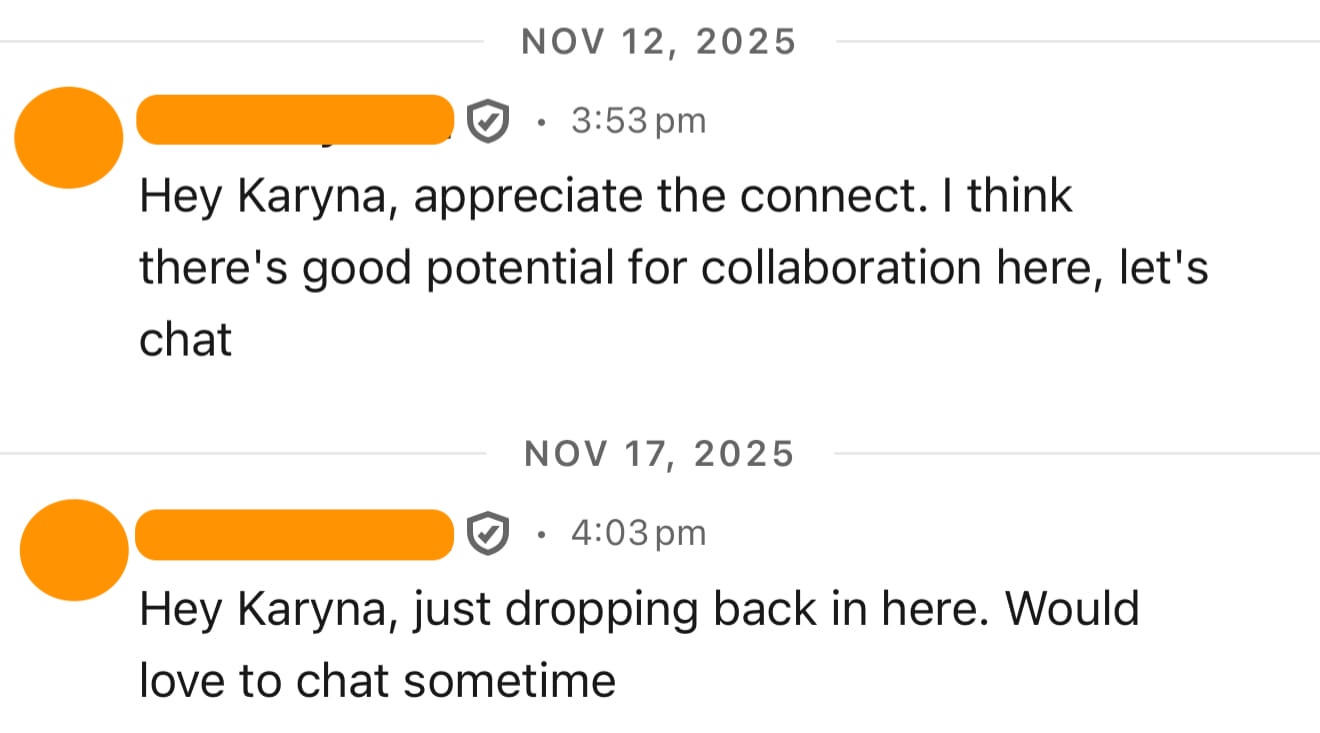
My first thought when I read that was, "I don’t want to respond just because I don't understand what the offer is, and I don't want to waste my time trying to figure it out." I personally think that you should describe or talk about your offer in the first message.
We continued the conversation.
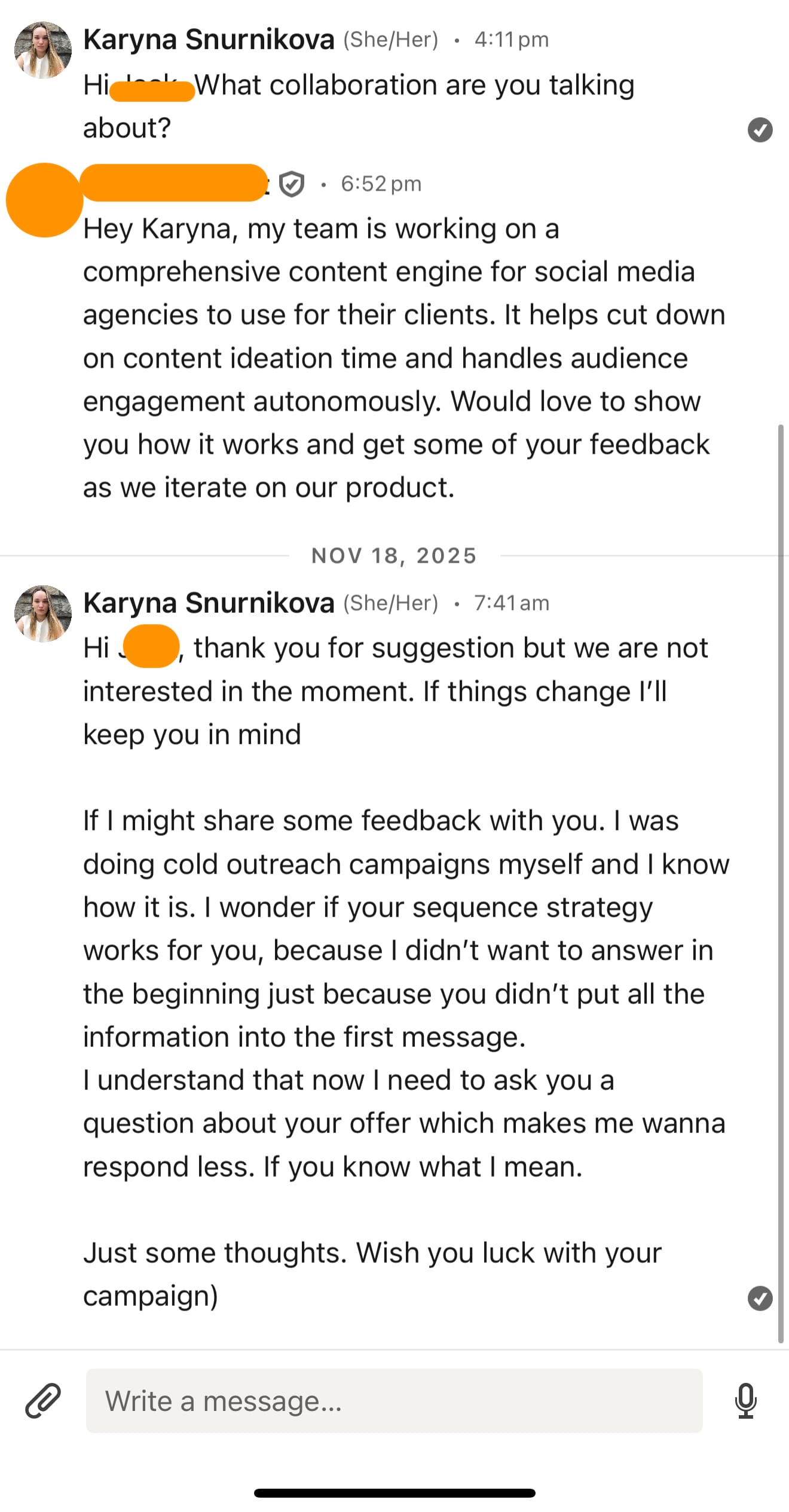
The offer itself sounds more like a favor the person is asking me to do rather than a valuable suggestion for me. I’d need to test the product and share my feedback while they make improvements based on that. It's not something I see value in.
I also left some feedback on the outreach message, but I didn’t hear anything back. I know some people might not like hearing it, but I was given it myself while I was doing outreach campaigns, and I always appreciated it. If it was a suggestion for improvement, of course, not just criticism.
Let’s move on to the next example.
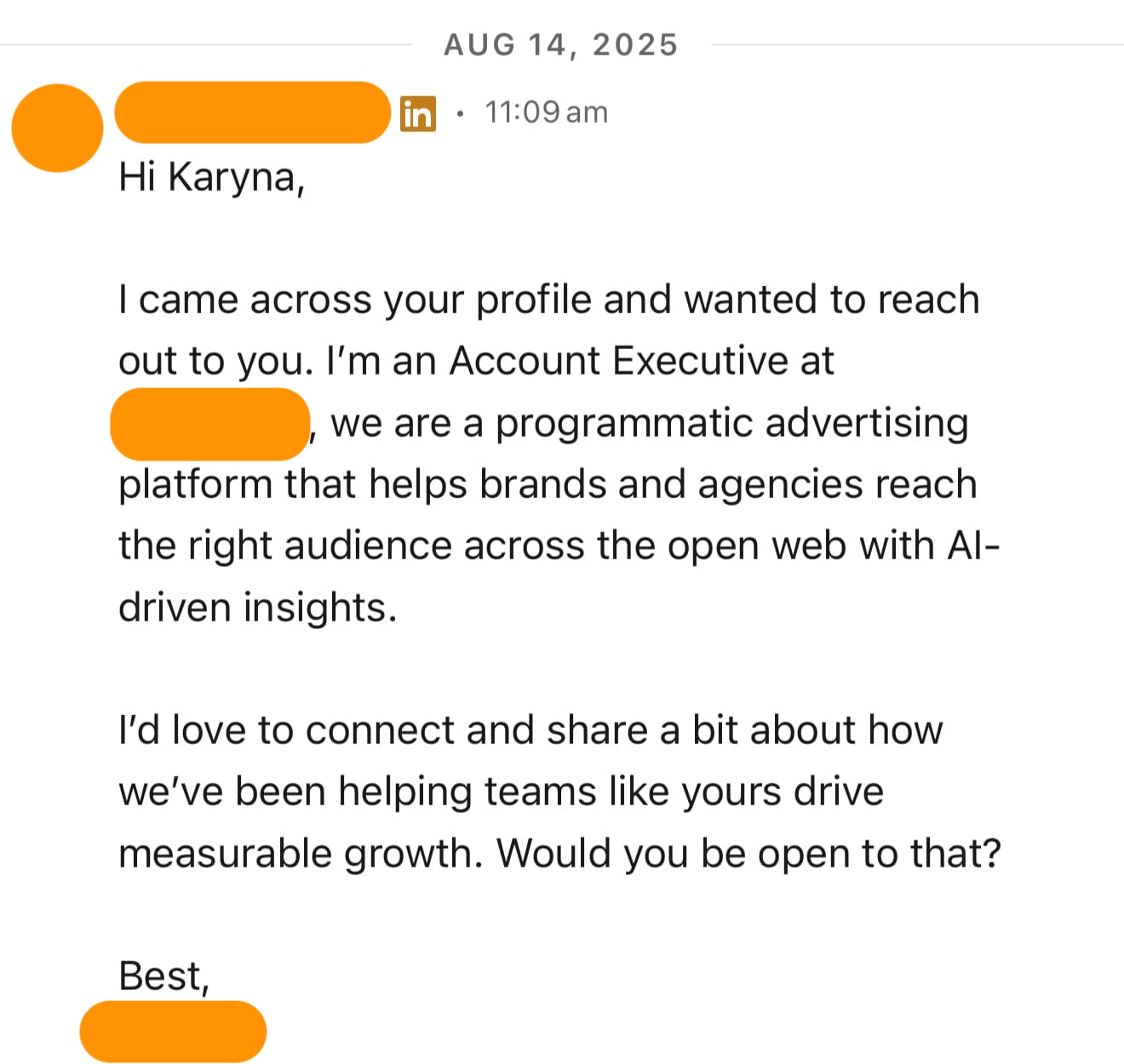
This message is much better and has almost everything. What could be done better here:
- Highlight the problem that I can possibly face in that area
- Give a particular example of how it can be solved
- Share a specific case with measurable results that the platform helped to achieve.
Would you agree?
I think the next message is very well written.
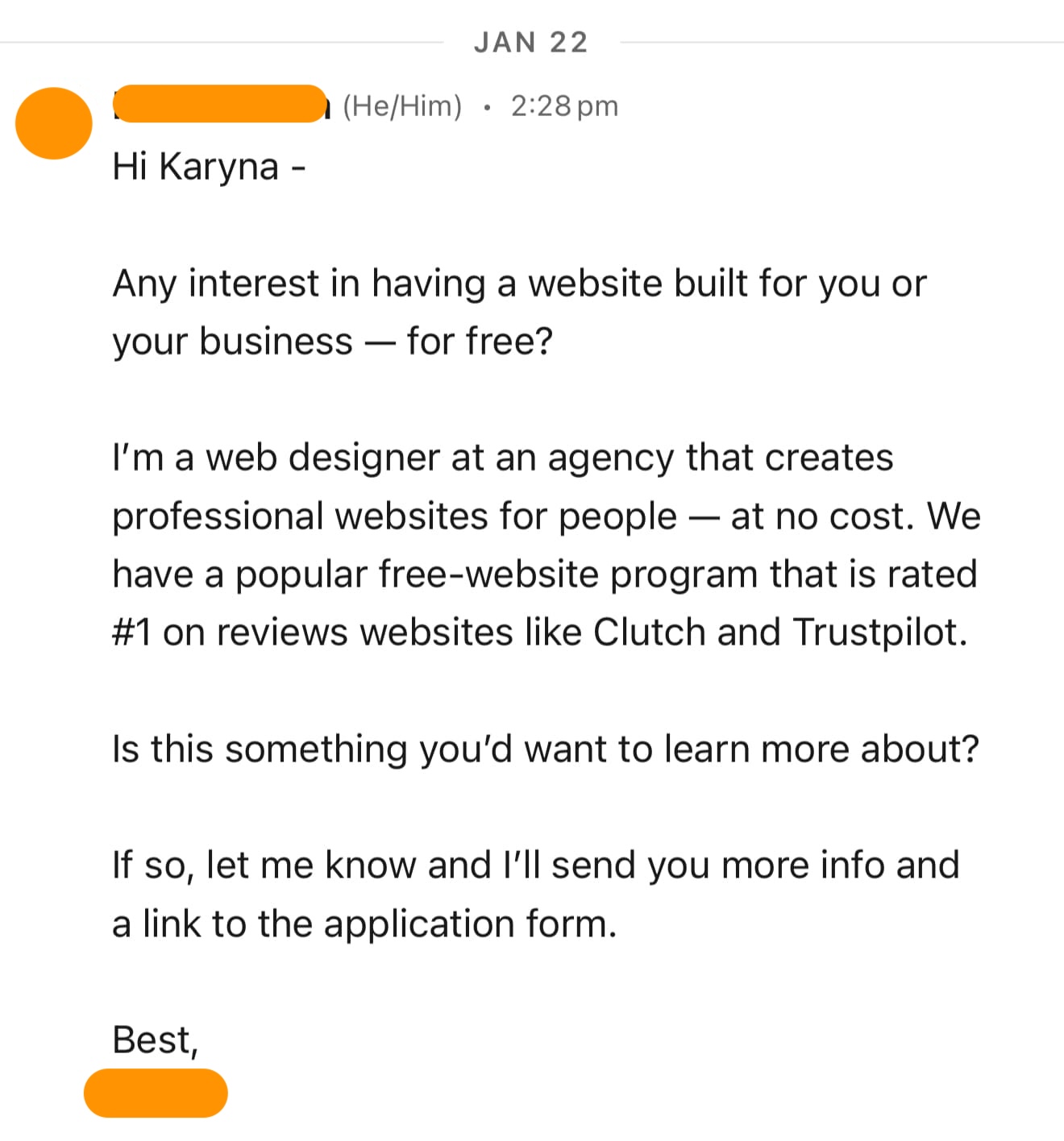
This message offers some great value—to build a website at no cost. I don’t know if they are good or not, but the offer is valuable.
I also got a follow-up.
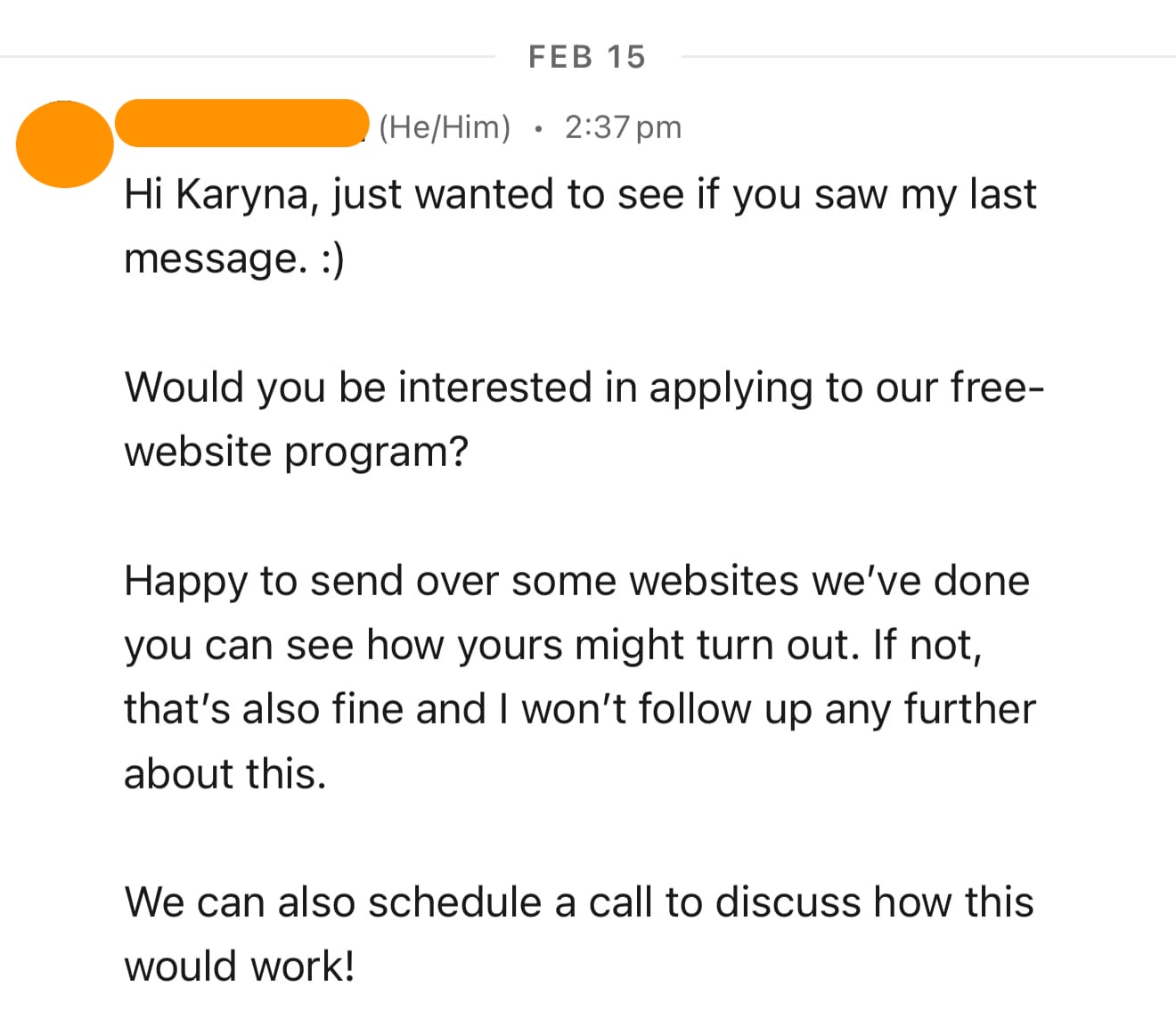
He offers something new in this message—to see some of the previous works. I did not need the service at the moment, so I politely declined, but we chatted for a little while, and I had a great impression overall.
Now I will show you a great email example.
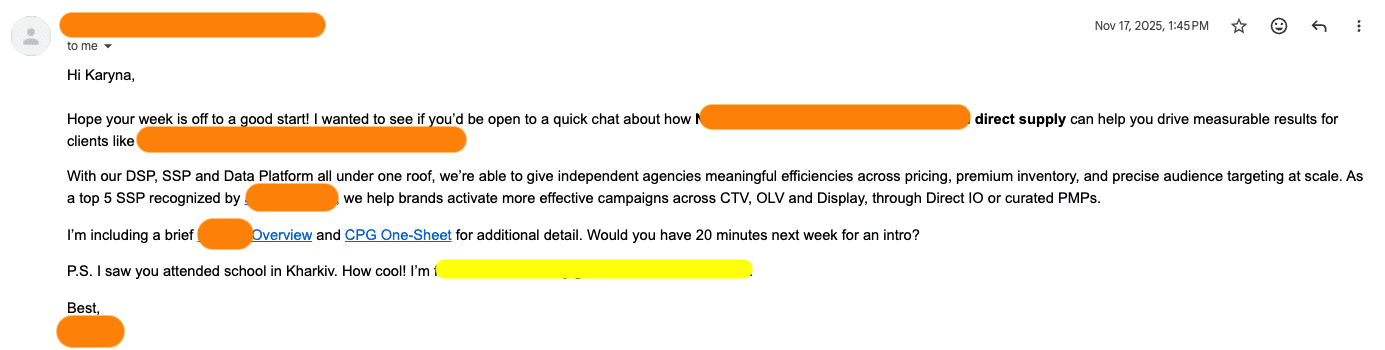
Some things that caught my attention in this message:
- He mentioned specific clients, which means that at least some research was done
- Added social proof, as their company was recognised (I hid by whom for privacy)
- Some additional documents included that expand more on the value
- He referenced something personal from my background. (I hid it in yellow color)
In that case, the message feels reasonable, trustworthy, and personal. I also received a follow-up message where he attached the insight deck for one of my clients. That was very personalized and helpful.
B2B cold emailing best practices: the dos and don'ts
I want to summarize everything that we talked about before and put it in a simple format.
The Dos:
✅ Do your research before writing any text
✅ Personalize the email subject line
✅ Follow a value-first approach
✅ Keep the message short and concise
✅ Add social proof to the text
✅ Add a clear CTA at the end
The Don’ts:
❌ Don't use "I hope this email finds you well."
❌ Don't use the same email copy for every prospect on your email list
❌ Don’t attach any files in the first email
❌ Don’t be annoying and pushy with follow-up messages
❌ Don't write something you are not sure about
Final thoughts on writing cold emails that work
I know that sometimes cold emailing can be confusing and frustrating, especially if you're starting from scratch or launching a new campaign, but the main thing is to be human and remember that you're writing to real people.
Try to imagine yourself on the opposite side of the screen and think about things that would catch your attention and bring you value. It always helps to put yourself in your customers' shoes.
I hope these proven B2B cold email templates will help you reach your ideal customers faster and get better results.
FAQ section
Disclosure: Some links in this article may be affiliate links. If you choose to make a purchase through them, Your Marketing Bowl may earn a commission at no extra cost to you.
The content on this site is for informational and entertainment purposes only and should not be taken as financial advice. For full details, see the disclaimers section.
The content on this site is for informational and entertainment purposes only and should not be taken as financial advice. For full details, see the disclaimers section.

Hey there! I'm Karina! I love marketing and everything about it. I've been working in marketing in Eastern Europe, Sweden, and now in Santa Barbara, CA. I hope you gonna like it here.

Subscribe for marketing advice
I'd actually give a friend
Join our mailing list and never miss a story.
No AI, no BS!