Cold email benchmarks 2026: reply rate, open rate & timing
Author:
Karina
Published:
Mar 19, 2026
Updated:
Jul 4, 2026
Reading Time:
12min
To be honest with you, when I started to collect some data for this article, I found a lot of cold email statistics that contradict each other.
Different data sources report different open and reply rate averages, best performing days of the week vary from Monday to Thursday, the number of recommended follow-up messages ranges from 1 to 7, etc.
How do you know what's true and what numbers you should rely on? I want to sort through this mess together.
I will walk you through the cold email stats I found and analyze the main benchmarks and metrics. I will also compare them to the results that I got when conducting cold outreach campaigns. Whether you're a marketer planning your first email campaign or a sales team trying to improve your sales pipeline, these numbers should help.
My goal with this article is to find some middle ground and define what numbers to rely on when planning your campaigns.
If you just need some quick data, here are some key metric averages:
1. Is a cold email campaign still worth it in 2026?
2. Average cold email response rate and open rate
3. How to write cold emails that get replies
4. Follow-up statistics: how many is too many
5. Best time to send cold emails in 2026 (and why the data conflicts)
6. Cold email deliverability and bounce rate: how to stay out of spam
Is a cold email campaign still worth it in 2026? Here's what the ROI data says
Great question, and believe me, a lot of people are asking the same thing.
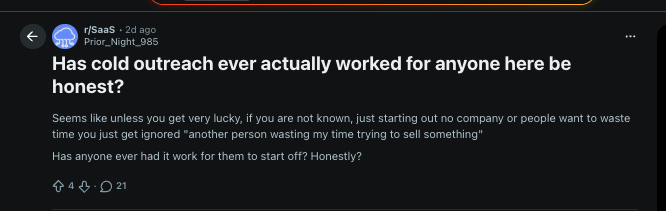
Some responses that I found in that thread.
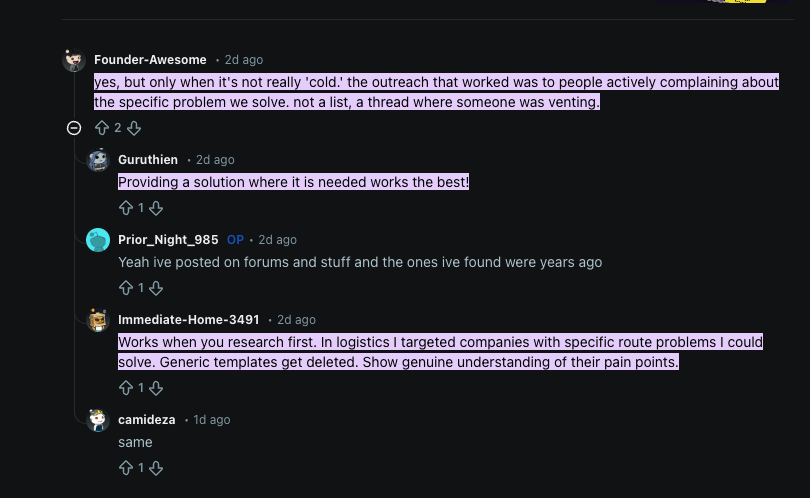
As you can see, opinions differ, and everybody is judging based on their own experience, which makes sense, but I want to look at the bigger picture here. Here are some stats in favor of B2B cold email:
→ Some researchers say that companies doing email marketing see a return of $10 to $50 for every $1 spent. That's one of the highest ROI numbers in digital marketing (Snov.io, Litmus).
I want to highlight that it's calculated based on the whole email marketing channel (including newsletters and warm campaigns), not separating cold email outreach campaigns. I could not find any research that focuses specifically on cold outreach, so we will work with what we have.
→ At the same time, 61% of B2B decision-makers still say they prefer being contacted via email over any other outbound channel.
Stats also show that in recent years, the average cold email reply rate dropped from 6.8% to 5.8% (Belkins). That signals email fatigue; people are getting more and more emails and feel overwhelmed by them.
I personally think that cold email remains effective — I see a lot of companies still doing it and getting better results than other outbound channels. But it's evolved and now requires a different approach.
Average cold email response rate and open rate: what "good" actually looks like
Let’s talk about cold email open rates first. Snov.io says that the average open rate for a B2B cold email is 27.7%. Meanwhile, Belkins reported that they achieved a 45.37% open rate in an outreach campaign with only 1 follow-up message. Saleshandy has an average open rate of 48.6%. That’s a big difference.
I don't think any of these reports are wrong; they just tracked different campaigns with different audience segments.
So what should you rely on while analyzing your campaign? I’d say an open rate above 30% can be considered a good result.
There is a big BUT that I need to talk about. The email open rate as a metric is becoming less reliable — and tracking it might even hurt your campaign performance. In Belkins’ report, they mentioned that due to changes in email spam policies, they decided to disable the open-rate tracking pixel and saw a 3% higher average reply rate in campaigns without the pixel.
This is something to keep in mind — spam filters are making open rates less trustworthy.
That means we should focus on metrics that actually matter, such as reply rate, conversion rate, and number of meetings booked (booking is what really matters for your sales pipeline). I'm not saying we should stop tracking open rates altogether; it's still helpful to know, but I’d suggest shifting your focus towards actionable metrics rather than vanity metrics.
The next logical question is, "Ok, so what is the average response rate that I should aim for in my cold outreach campaign?” As I said, data varies, but here’s something you can lean on.
→ Instantly (2026): 3.43%
→ Belkins (2025): 5.8%
→ Saleshandy (2025): 8.2%
How could we explain this difference in average cold email response rates?
Those studies analyzed different sample sizes and campaign types. Instantly says that their report analyzed billions of cold email interactions coming from thousands of active workspaces (which I think included newer companies with unproven domains and bad contact lists).
Belkins uses more professional targeting, meaning their cold leads are probably “warmer” compared to companies analyzed in the Instantly study.
That means that each number is correct for its own context. With all that in mind, here’s my baseline for the response rate metric:
→ Below 3% = something's broken (list quality, deliverability, or messaging)
→ 3–5% = average
→ 5–10% = good
→ 10%+ = extremely good
So, how do you make cold emails fall in the 'extremely good' category? Let’s try to figure it out.
How to write cold emails that get replies: subject line, personalization, and length stats
Cold email subject lines: what gets opened vs. what gets spam-filtered
Statistics show that 69% of email recipients report email as spam based on the subject line alone. Here are some things to consider:
→ Best subject line length: 36–50 characters get the highest response rates.
→ A personalized subject line gets a 30.5% higher response rate.
→ Including numbers in subject lines increases opens by 45%.
Now think about how your email subject lines usually look. Are they personalized? Do they include value in numbers and measurable results? What has worked for you and what hasn't?
Some examples of subject lines to consider:
Does personalization actually increase reply rates?
You can see in the table below how personalization affects open rates and reply rates. I’d like to clarify a couple of things for this table. Basic personalization here is the person's name and the company name, while advanced personalization includes additional personalization snippets.
As you can see, personalization wins. Now the question is, how do you approach personalization, and what do you include in there?
I think including the recipient's name in the email or message is something non-negotiable. This part of personalization should always be present.
Some things that I included in the personalized cold emails that worked were: mentioning a recent post, referencing a career change, citing company news, and bringing up the company's website traffic (sometimes the traffic topic turned into a negative conversation, but definitely increased the reply rate 😂).
* I studied the company's website traffic to suggest solutions that could improve it and bring them new leads. Even though I checked traffic on the well-known and trusted resource (Ahrefs), people I reached out to claimed that their real traffic is different (and they might be right, since nothing tracks it better than your own GA4).
How long should a cold email be?
Belkins recommends keeping your email in the 101–200-word range since, according to their study, those emails got the best response rate (6.8%), while emails with 600+ words were at the very bottom of performance at a 4%.
I generally agree with this recommendation; the only exception is if you want to send a follow-up email with a personalized solution/suggestion. You might need more words to expand on the topic.
Follow-up statistics: how many is too many
Some data shows that follow-up outreach emails collectively generate 42% of all campaign replies. And yet, 48% of reps don't ever make a single follow-up attempt after the initial email — which I think is a mistake.
I advocate for follow-up messages in the sequence. I’ve seen how they improve campaign results. There is one important thing to keep in mind, though. You shouldn’t spam your prospects with a high number of emails and be pushy.
Belkins found that the first follow-up gets 8.4% reply rate (peak), but by the 5th follow-up, it drops to 3.8%. And after 4+ follow-ups, you TRIPLE your spam and unsubscribe risk.
Three follow-up messages are a sweet spot, and going past that hurts you.
I receive cold outreach emails and LinkedIn messages on a regular basis, and I know that I might answer something after the second or third message if it’s written well. I wrote a separate article about actual email examples that I get and give templates that you can use to write your own emails. Check it out if you are a visual learner.
Best time to send cold emails in 2026 (and why the data conflicts)
Three main studies from Snov.io (2025), Instantly.ai (2026), and Saleshandy agree that the best time for sending cold emails is mid-week: Tuesday through Thursday, 9:30–11:30 AM recipient's local time.
When it comes to which day outperforms the rest, the statistics differ. To be honest, I don’t think the exact day of the week (especially if we are choosing between Tue, Wed, and Thu) will save or kill your cold email campaign.
My best advice here is to test it with your own audience and see what would work best for your outreach strategy. Some VPs check their inbox when their kids go to bed, while marketing managers scan theirs in the morning hours.
Some things to avoid:
→ Sending emails late at night
→ Sending emails late on weekends
→ Sending emails in December since it is the worst month in terms of response rate (only 4.6%)
Cold email deliverability and bounce rate: how to stay out of spam
General cold email stats on bounce rate and unsubscribe rate:
→ Average unsubscribe rate is 2.17%
→ Average bounce rate is 7.5%
→ You can consider 95% a good deliverability benchmark
According to the Saleshandy report, the main reasons for bounces are:
→ 49% = invalid or outdated email addresses (bad data)
→ 23% = domain reputation issues
→ 17% = aggressive sending patterns
→ 11% = missing SPF/DKIM/DMARC authentication
Starting from 2024, SPF, DKIM, and DMARC are no longer optional due to Gmail protections. All email service providers now check for these. If you're missing them, your deliverability is compromised before you even send your first email.
To avoid ending up in a spam folder, try to keep your daily send limit under 100 emails per inbox. You can also send emails from different inboxes as a sender rotation strategy — for example, from different team members' accounts. This way you can make each email more personalized at the same time.
You can also warm up your domain before the first cold outreach campaign. Snov.io offers this feature on its platform. If you are wondering what platforms you can use for your outreach, I have a whole article about it.
FAQ: cold email statistics
Disclosure: Some links in this article may be affiliate links. If you choose to make a purchase through them, Your Marketing Bowl may earn a commission at no extra cost to you.
The content on this site is for informational and entertainment purposes only and should not be taken as financial advice. For full details, see the disclaimers section.
The content on this site is for informational and entertainment purposes only and should not be taken as financial advice. For full details, see the disclaimers section.

Hey there! I'm Karina! I love marketing and everything about it. I've been working in marketing in Eastern Europe, Sweden, and now in Santa Barbara, CA. I hope you gonna like it here.

Subscribe for marketing advice
I'd actually give a friend
Join our mailing list and never miss a story.
No AI, no BS!